




Naval Forces News
Electronic Systems


BREAKING NEWS
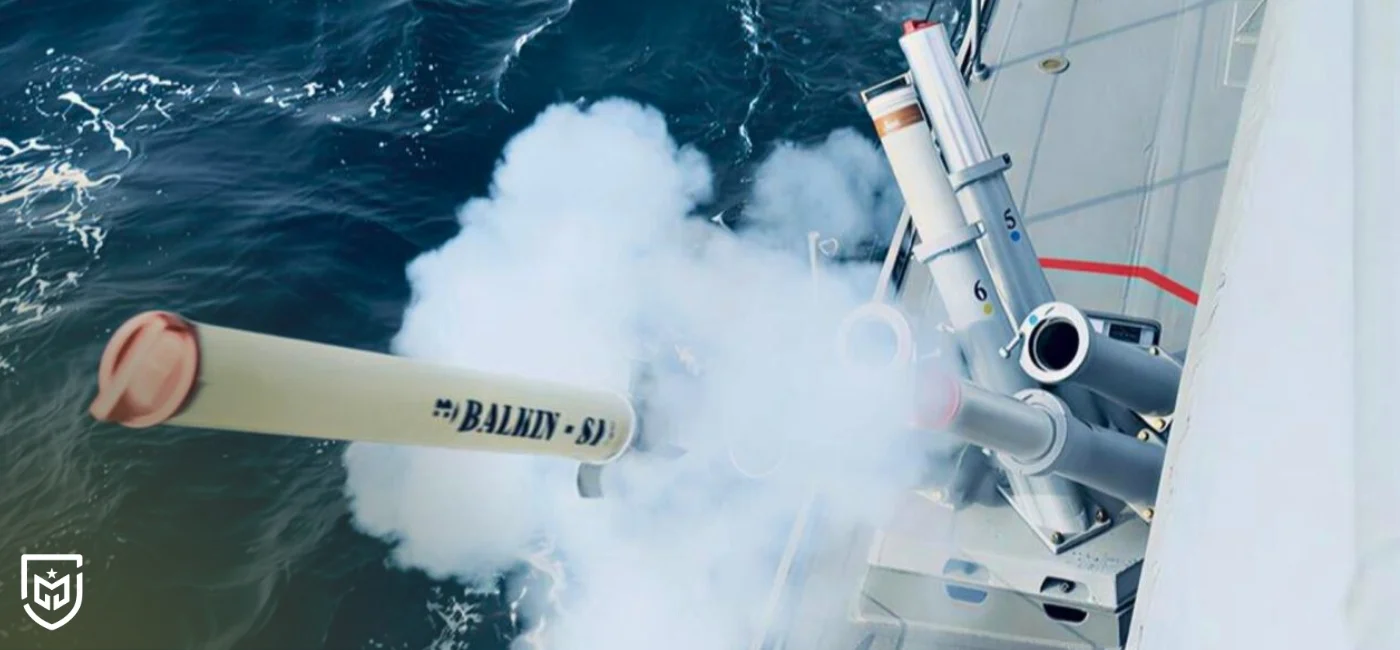
Turkey’s defense industry continues its steady march toward full self-sufficiency, with another critical naval capability now produced domestically. The BALKIN Soft-Kill Decoy Ammunition System, developed by MKE, has successfully completed all qualification and firing tests and is officially ready for serial production. This development ends Turkey’s reliance on foreign suppliers for a key layer of warship self-defense.
BALKIN is designed to protect naval platforms against one of the most dangerous modern threats: anti-ship guided missiles. Once an incoming missile is detected, the system deploys a special ammunition filled with metallic particles that detonate at an optimal point in the air. This detonation creates a dense cloud of fragments and electromagnetic signatures, deceiving the missile’s seeker head into locking onto the false target instead of the ship. As a result, the missile is diverted away from the vessel and neutralized before it can reach its intended target.
Experts emphasize that BALKIN functions as an invisible defensive shield for warships, significantly increasing survivability in high-threat environments. Unlike previously imported systems, BALKIN was developed entirely in line with the operational requirements of the Turkish Navy. This “tailor-made” approach allows the system to be optimized based on real operational feedback, giving it a performance advantage over its foreign counterparts.
MKE’s increasing presence in naval defense systems is also seen as a strategically sound move. Rather than duplicating systems already produced by other Turkish defense companies, MKE focused on critical areas where no domestic solution previously existed. This approach not only increases localization rates but also enhances export potential. Defense analysts believe that BALKIN can be integrated both as part of complete naval platforms and as a standalone system, making it attractive to foreign navies seeking effective and cost-efficient missile defense solutions.
With BALKIN, Turkey once again demonstrates its ability to transform dependency into self-reliance while delivering systems that compete with—and in some cases surpass—international equivalents.


The cookies used on our website are used to provide you with a better user experience and to improve our website. You can manage your cookie preferences from the options below.
 Süheyla Yıldız
Post Comment
Comments
No comments yet.
Related News
Thales Introduces HexaForce AI-Powered Command and Control System to Gulf Region
ÇEPNI Tactical UAV Family Enters Operational Service
ASELSAN's Drone-Hunting System Completes Successful Demonstration
ASELSAN's GÖKALP drone defense system completes successful demonstration
SSB Chief Görgün Warns Against Open Source Intelligence Risks
SSB Chief: Localization in Defense Projects Starts from Design Phase
AKINCI UAV Successfully Tested with MORFOZ Guidance Kit
Ireland selects Thales Ground Master radar for air surveillance capability