Operational Purpose and Role
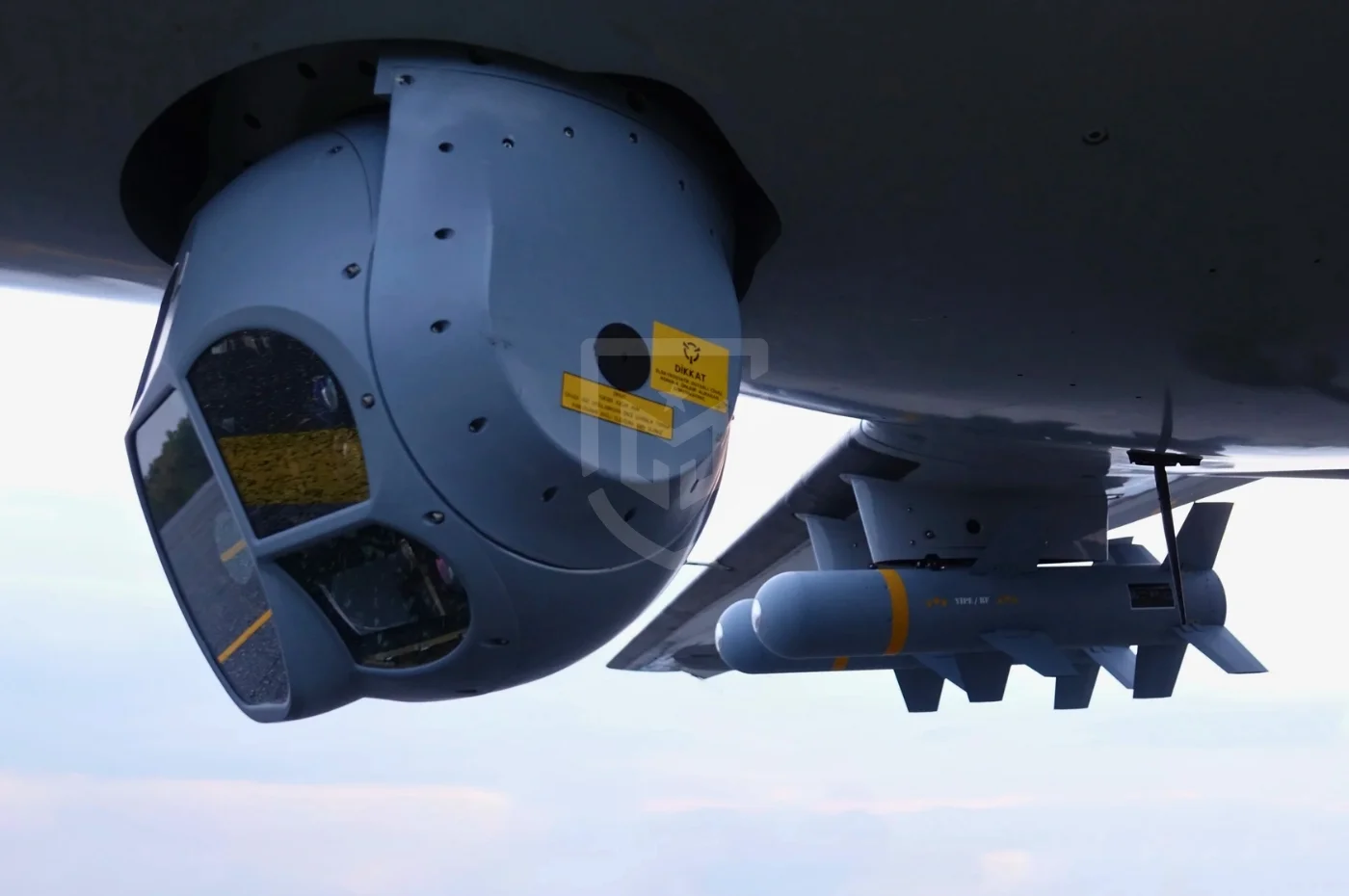
ASELFLIR-300T is designed to provide Intelligence, Surveillance and Reconnaissance (ISR) and precision targeting capabilities from airborne platforms. It enables detection, identification, tracking and laser designation of stationary and moving targets within a single stabilized EO/IR turret system.
Its primary operational roles include:
- Precision targeting on armed UAVs
- Laser designation for guided munitions
- Persistent wide-area surveillance
- Border security and counter-terrorism operations
- Tracking and identification of high-value targets
Doctrine and Concept of Operations
ASELFLIR-300T operates within a network-centric warfare and sensor-to-shooter framework. The system detects and tracks a target via IR or TV sensors, calculates target coordinates, and provides laser designation for precision-guided munitions during the terminal phase.
It plays a critical role in:
- Sensor-shooter integration
- Precision-guided munition (PGM) operations
- 24/7 ISR missions
- Detection of low-signature and camouflaged targets
Platform Architecture
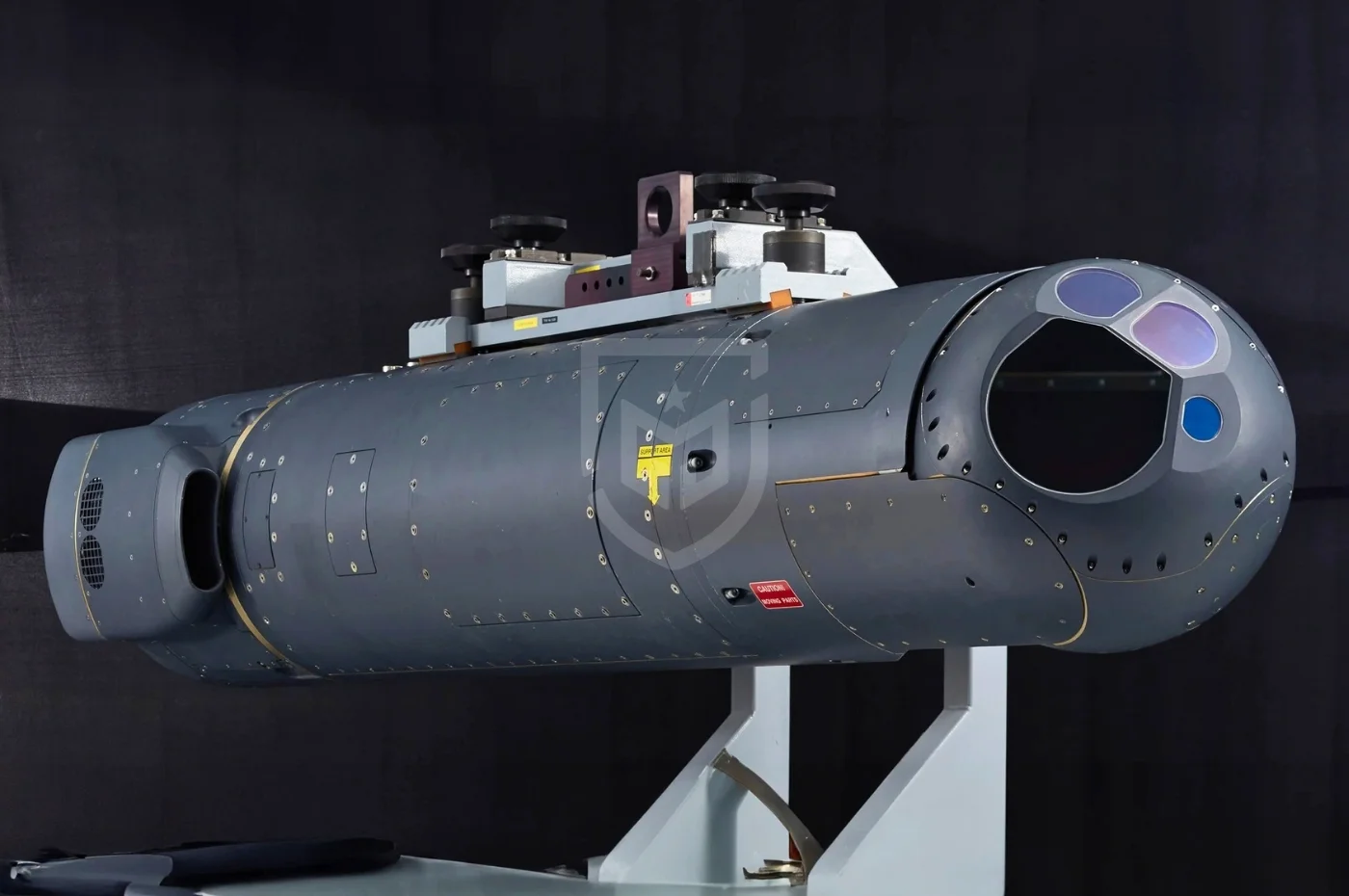
The system integrates multiple subsystems within a stabilized turret:
- High-resolution cooled infrared camera
- Daylight TV camera (configurable options)
- 3-CCD color identification camera
- Laser target designator
- Laser rangefinder
- Inertial Measurement Unit (IMU)
- 4-axis stabilization system
- Embedded image processing and automatic tracking algorithms
Communication interfaces include MIL-STD-1553B and RS-422, along with analog and digital video outputs for integration with mission computers.
Survivability and Stabilization
ASELFLIR-300T is engineered to operate under high vibration and aerodynamic loads typical of UAVs and fixed-wing aircraft. The 4-axis stabilization:
- Maintains image clarity during maneuvering
- Minimizes angular deviation in laser designation
- Enhances long-range precision
This is particularly critical when operating at engagement distances approaching 15–20 km.
Accuracy, Reaction and Engagement Process
Typical engagement sequence:
- Target detection via IR or TV sensor
- Automatic target tracking activation
- Laser range measurement
- Target coordinate generation
- Laser designation
- Terminal guidance of the munition
The system supports multi-target tracking. Exact reaction time values are platform-dependent and not publicly disclosed.
Integrated Ecosystem
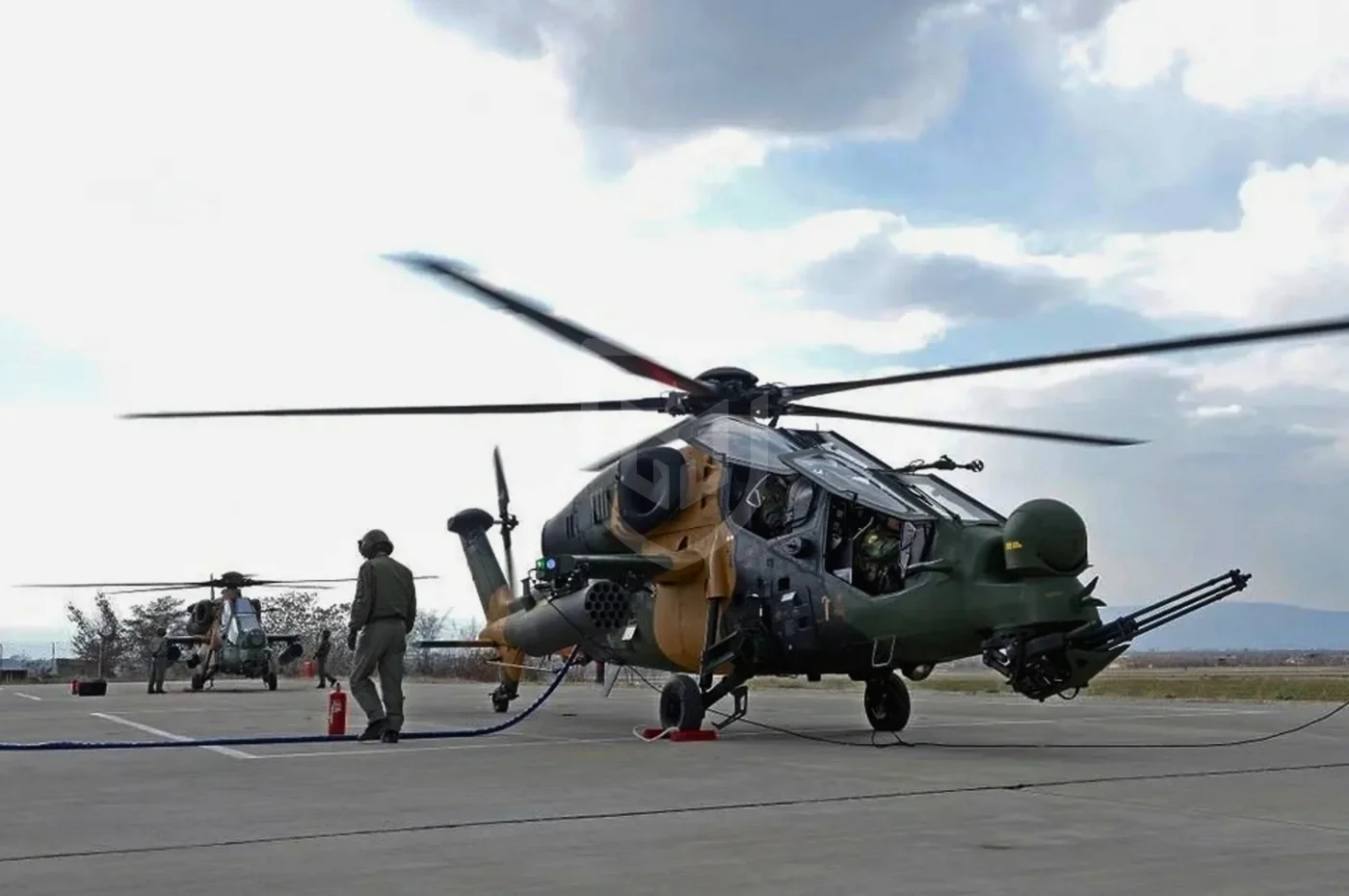
ASELFLIR-300T has been integrated into various Turkish UAV platforms developed by:
- Baykar
- Turkish Aerospace Industries
Integration specifics vary depending on aircraft configuration and mission requirements.
Advantages Against Modern Threats
- Full night operation capability
- High precision laser designation
- Long-range passive IR detection
- Network-enabled operational compatibility
- Effective performance against low-visibility targets
Limitations
- Performance may degrade in heavy fog, dense clouds or sandstorms
- Laser designation requires line-of-sight
- Operational effectiveness depends on platform altitude and sensor configuration
Variants and Family Context
Within ASELSAN’s FLIR product family, ASELFLIR-300T serves the medium-class UAV segment. Other variants (e.g., higher-class systems) may offer extended range and higher resolution configurations.
Detailed Technical Specifications
Physical Characteristics
- Stabilized EO/IR turret configuration
- 360° continuous azimuth rotation
- Configurable elevation angles
- Exact weight and dimensional data are not fully disclosed in open sources
Infrared Camera
- Resolution: 1440 × 576
- Cooled infrared sensor
- Multiple Field of View (FOV) options
- Optimized for night and low-visibility operations
Daylight TV Camera
- 3-CCD color separation system
- High optical zoom capability
- Long-range identification performance
Laser Systems
- Laser target designator
- Laser rangefinder
- Maximum ranging capability: up to 20 km (open-source data)
Stabilization
- 4-axis stabilization
- Integrated IMU
- High angular precision
Communication Interfaces
- MIL-STD-1553B
- RS-422
- Analog and digital video outputs
Target Tracking
- Automatic target tracking
- Multi-target tracking capability
- Moving target speed and direction estimation
Electronic Warfare Resilience
Detailed ECCM and resistance parameters are not publicly disclosed.
Deployment and Integration
- Airborne platform integration
- Optimized for UAV applications
- Requires mission computer integration
Frequently Asked Questions
What is ASELFLIR-300T used for?
- It provides reconnaissance, surveillance, and laser target designation capabilities, primarily for armed UAVs supporting precision-guided munitions.
What is its maximum range?
- The laser rangefinder capability is reported as up to 20 km. Detection and identification ranges vary depending on target size and atmospheric conditions.
What targets is it effective against?
- Stationary and moving ground targets, light armored vehicles, personnel groups and tactical assets.
Does it operate at night?
- Yes. The cooled infrared camera enables full night operation.
How many targets can it track simultaneously?
- It supports multi-target tracking; however, exact numerical limits are not publicly disclosed.
Is it mobile or fixed?
- It is a stabilized turret system integrated onto airborne platforms, not a fixed ground installation.
What are its international equivalents?
- Comparable systems exist in the global EO/IR turret market segment. Technical comparisons depend on specific configuration and mission profiles.
Sources
- ASELSAN official product page and brochures
- ASELSAN annual reports
- Public statements from Turkish defense authorities
- Open-source defense industry publications