



Air Forces News
Global Developments


BREAKING NEWS
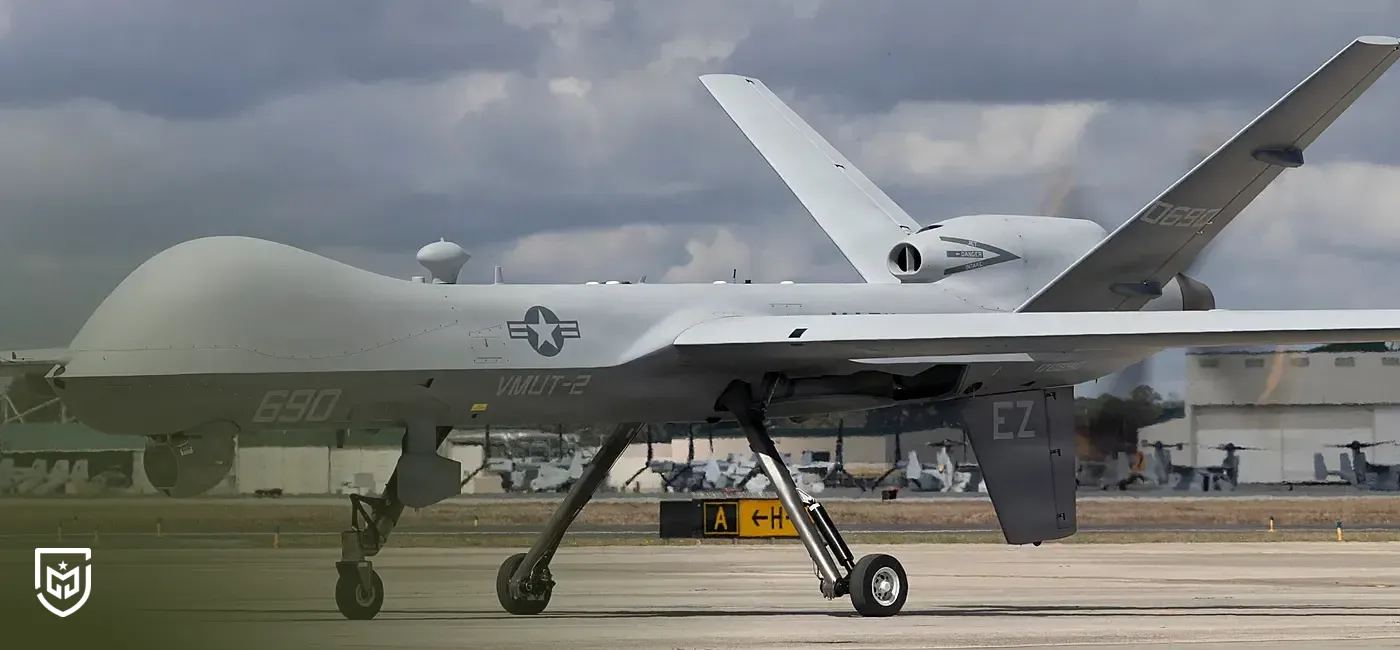
The U.S. Air Force's inventory of MQ-9A Reaper unmanned aerial vehicles has declined to approximately 135 platforms. This figure represents less than half of the 351-aircraft fleet reported in fiscal year 2022. The reduction stems from accidents, combat losses, and planned retirement of older variants. The Congressional Research Service (CRS) confirmed these figures in a report released on September 23, 2026.
Manufactured by General Atomics Aeronautical Systems, the MQ-9A is powered by a 900-shaft-horsepower Honeywell TPE331-10GD turboprop engine. The platform features a 20.1-meter wingspan, maximum takeoff weight of approximately 4,760 kilograms, and operational ceiling of 50,000 feet. Equipped with a Multi-Spectral Targeting System (MTS) providing infrared, electro-optical, and laser designation capabilities, the system can carry up to eight AGM-114 Hellfire missiles alongside GBU-12, GBU-38, and GBU-54 munitions. Its approximately 1,000 nautical mile operational range enables extended presence for intelligence, surveillance, and reconnaissance (ISR) missions.
From the Turkish defense industry perspective, medium-altitude, long-endurance (MALE) unmanned aerial vehicles like the MQ-9A have directly influenced the design and operational concepts of Turkey's Bayraktar TB2 and AKINCI platforms. Systems developed by Baykar have achieved comparable capabilities to the MQ-9A's proven ISR and precision strike functions through indigenous technology. Turkey's UAV ecosystem has evolved based on global standards and operational experience, increasing localization rates and establishing the nation as a significant defense industry exporter.
The decline in the U.S. MQ-9A fleet represents a significant indicator in the global UAV market. Reaper has been operational since 2007, seeing intensive use in Afghanistan, Iraq, Syria, and most recently Iranian operations. The platform was designed to NATO standards and has been preferred by allied nations. However, the production line closure and extended restart timeline signal a turning point in U.S. UAV strategy. Since the Massed Modular Aircraft (MMA) program remains in development, no successor system currently exists to replace the MQ-9A in the near term.
The current 135-aircraft MQ-9A fleet can theoretically sustain 56 global combat lines, yet continuous operational activity requires multiple aircraft per line. The flexibility margin needed for maintenance, training, rotation, and wartime losses has been significantly reduced. Production line restart is planned within 2-3 years, and the U.S. Air Force did not request new MQ-9A procurement in its fiscal 2027 budget proposal. This indicates the service plans to address future platform requirements through the MMA program.


The cookies used on our website are used to provide you with a better user experience and to improve our website. You can manage your cookie preferences from the options below.
 Tolga Demirel
Post Comment
Comments
No comments yet.
Related News
HAVELSAN Explores Defense Technology Opportunities in Azerbaijan Market
Teknofest Southeast Opens in Şanlıurfa
KAYI Defense showcases national ammunition products at ADEX 2026
US AMRAAM Production Capacity Reaches Record Levels with $20.7 Billion Contract
Teknofest Opens in Şanlıurfa: Five Days of Aviation and Technology Showcase
ASELSAN's KANGAL and EJDERHA Systems Provide Dual Defense Against Drone Threats
SAHA Istanbul: Turkish Defense Industry Must Capture Global Market Share
Canik to strengthen Turkey-Azerbaijan defense partnership at ADEX 2026