





Naval Forces News
Electronic Systems


BREAKING NEWS
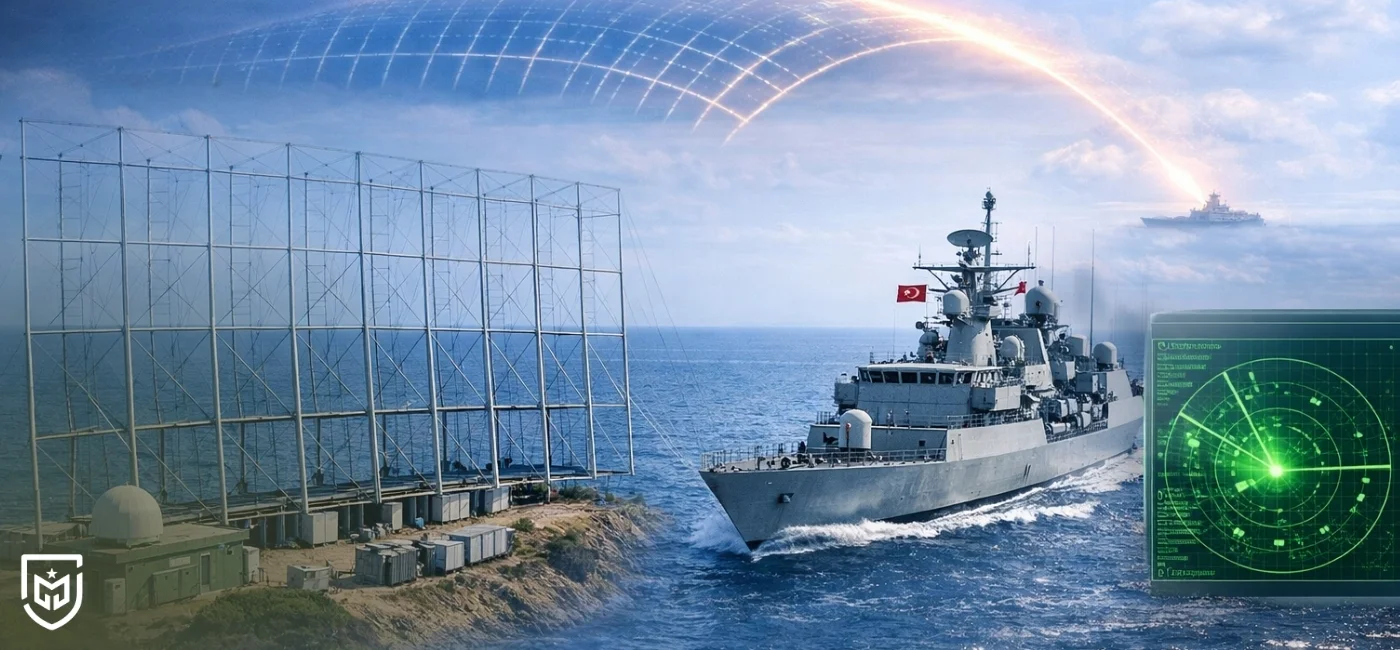
According to TÜBİTAK’s 2025 activity report, the YDYFR project developed for the Turkish Naval Forces has officially been completed, marking a notable step in Türkiye’s effort to enhance its maritime domain awareness. The project stands out as an important technological milestone designed to support long-range surveillance across wide sea areas. At a time when naval operations increasingly depend on early warning, uninterrupted tracking, and accurate situational awareness, the completion of such a system reflects Türkiye’s broader ambition to strengthen indigenous defense technologies for use in complex maritime environments.
YDYFR is described as a High Frequency Surface Wave Radar core system, a class of radar designed to detect targets well beyond the line-of-sight limits of conventional radar systems. Unlike traditional radars that are restricted by the curvature of the Earth, surface wave radars use HF-band signals that propagate along the sea surface, allowing them to monitor distant targets over much greater ranges. This capability provides a major operational advantage in coastal surveillance, early detection of naval movements, and the monitoring of strategic waterways. In practical terms, such systems can significantly extend a navy’s ability to observe activity in surrounding maritime zones without relying solely on airborne or satellite-based assets.
The completion of YDYFR is especially important for the Turkish Naval Forces, which operate in highly sensitive and strategically significant maritime regions. A radar system of this kind can contribute to the detection and tracking of surface vessels far from shore and may also support the monitoring of certain low-altitude aerial targets depending on operational conditions. Beyond surveillance, the data produced by such systems can improve command decision-making by offering a broader and more persistent operational picture. This can be highly valuable in both peacetime maritime security missions and high-tempo military scenarios where reaction time is critical.
From a wider defense perspective, YDYFR also represents the growth of Türkiye’s domestic expertise in advanced radar and sensor technologies. Systems in this category are generally considered infrastructure-intensive and strategically valuable, as they can serve not only in surveillance roles but also in supporting wider coastal defense and targeting networks. With the project now completed, YDYFR is likely to be viewed as a significant indigenous achievement that could enhance Türkiye’s naval preparedness, maritime monitoring coverage, and long-range detection capabilities in the years ahead.


The cookies used on our website are used to provide you with a better user experience and to improve our website. You can manage your cookie preferences from the options below.
 Süheyla Yıldız
Post Comment
Comments
No comments yet.
Related News
ASELSAN's Electro-Optical System Integrated into South Africa's Mwari Aircraft
Bayraktar AKINCI Successfully Strikes Target with TOLUN-P in Electronic Warfare Environment
TCG Karadeniz launched into service
ASELFLIR-500 Integrated into South Africa's Mwari Aircraft
ASPILSAN Energy introduces portable power systems
Surveyor USV Demonstrates Operational Capability with JAGM Missile at RIMPAC
KAAN to receive domestic engine: 2033 target set
Israel Converts Business Jet into Multi-Mission Intelligence Platform