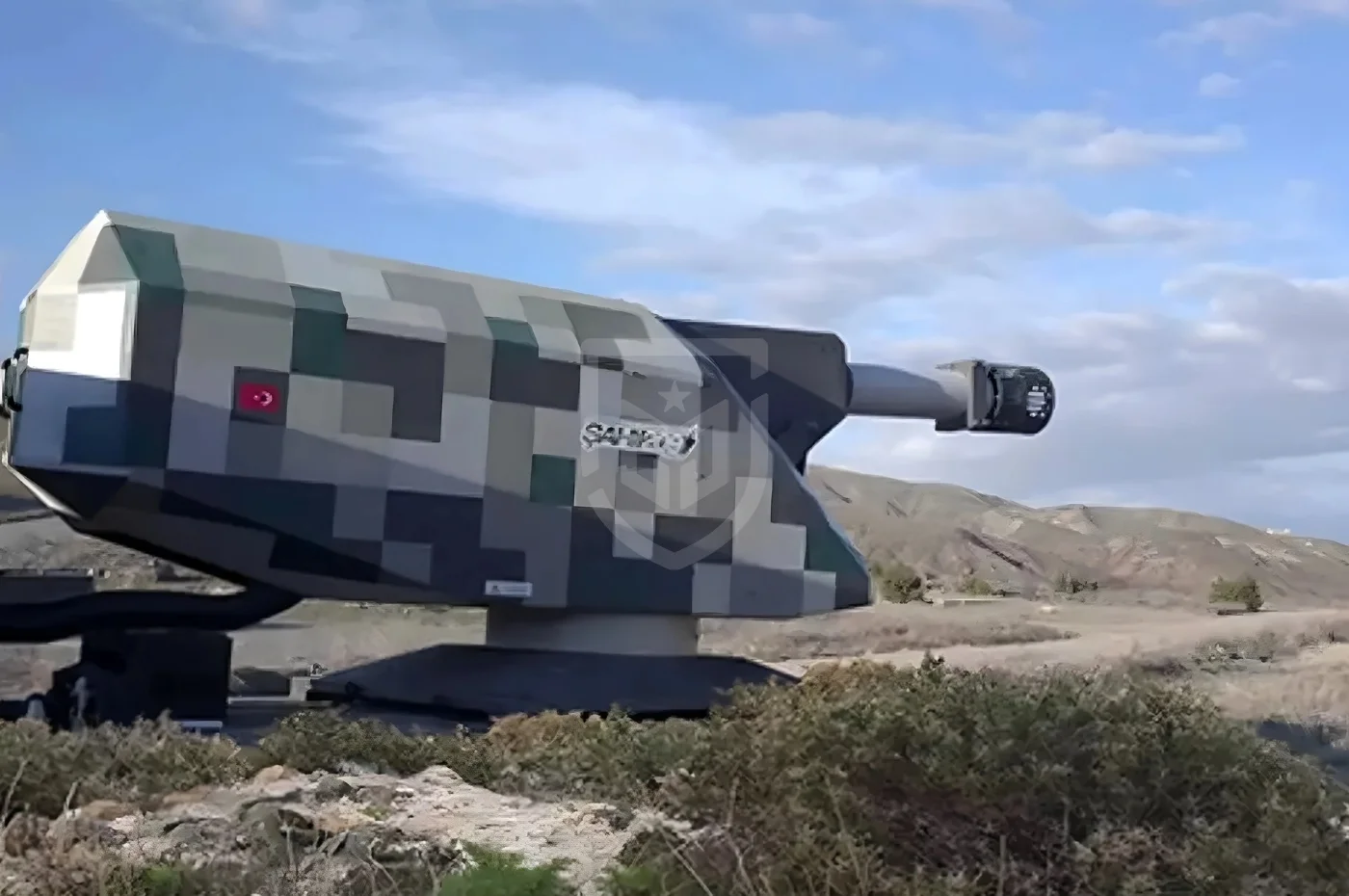



ŞAHİ-209 represents Turkey’s private-sector initiative in the field of electromagnetic artillery systems. Unlike conventional gun systems that rely on explosive propellants, electromagnetic guns use extremely high electrical currents to generate Lorentz force along conductive rails, accelerating a projectile to very high velocities.
Operational Purpose and Role
The conceptual mission profile of ŞAHİ-209 includes:
- Long-range land-based fire support
- Coastal defense against naval targets
- Potential naval main gun integration
- Experimental high-velocity strike platform
The system’s claimed hypersonic projectile velocity (Mach 6+) significantly reduces time-to-target, which in theory enhances lethality against:
- Surface naval vessels
- Fixed land targets
- High-value infrastructure
- Time-sensitive targets
However, there is no publicly verified data confirming operational interception capabilities against ballistic or hypersonic threats.
Doctrine and Concept of Use
Electromagnetic artillery systems are built around three core principles:
- High muzzle velocity
- Kinetic energy-based destruction
- Elimination of explosive propellants
ŞAHİ-209’s projectile concept reportedly focuses on kinetic energy impact rather than explosive warheads. This approach provides:
- Reduced ammunition storage risk
- Lower logistical complexity
- Potentially lower per-shot cost
- Increased safety during transport and handling
In a doctrinal framework, such systems could complement traditional artillery and missile systems rather than fully replace them.
Platform Architecture
Although detailed architecture data is not publicly disclosed, an electromagnetic launch system like ŞAHİ-209 necessarily includes:
- High-energy pulsed power supply (1 MJ and 10 MJ variants)
- Energy storage modules (likely capacitor banks; specific type not publicly disclosed)
- Conductive rail barrel assembly
- Fire control and power management system
- Thermal management and cooling infrastructure
Block1 is described as a 1 megajoule-class system with 10 km range, while Block2 reportedly delivers 10 megajoules and 50 km range, with a system length of approximately 7 meters.
These figures are based on company statements; independent validation is not publicly available.
Survivability and Safety Approach
One of the primary advantages of electromagnetic systems is the absence of chemical propellants. This reduces:
- Secondary explosion risks
- Ammunition storage hazards
- Logistics vulnerability
However, survivability challenges include:
- Extremely high electrical power requirements
- Large energy generation infrastructure
- Rail erosion and wear
- Thermal stress management
No public endurance or lifecycle testing data has been disclosed.
Accuracy and Engagement Process
The system reportedly launches low radar cross-section projectiles at hypersonic speeds. In theory, this enables:
- Reduced flight time
- High kinetic penetration
- Limited interception window
However, the following data points are not publicly available:
- CEP (Circular Error Probable)
- Guidance mechanisms (if any)
- Terminal correction capability
- Integrated radar or external targeting systems
Therefore, precision strike capability remains unverified in open sources.
Advantages and Limitations Against Modern Threats
Potential Advantages:
- Hypersonic muzzle velocity
- Kinetic-only projectile
- Reduced ammunition logistics footprint
- Lower radar detectability of projectile
Limitations:
- Extremely high energy consumption
- Power generation and mobility constraints
- Rail degradation after repeated firing
- Infrastructure dependency
Electromagnetic systems globally remain technologically challenging, and no country has yet fielded a widely deployed operational railgun system.
Variants
Block1
- 1 MJ pulsed power
- 10 km stated range
Block2
- 10 MJ pulsed power
- 50 km stated range
- Approximately 7 meters in length
These specifications are based on manufacturer disclosures.
Detailed Technical Information
Dimensions and Weight
- Length (Block2): Approx. 7 meters
- Weight: Not publicly disclosed
Power System
- Pulsed power levels: 1 MJ / 10 MJ
- Energy storage type: Not publicly disclosed
- Sustained rate of fire: Not publicly disclosed
Performance
- Claimed velocity: Mach 6+
- Range: 10 km (Block1), 50 km (Block2)
- Reaction time: Not publicly disclosed
Sensors and Fire Control
- Integrated radar: Not publicly disclosed
- External fire control integration: Likely required
- Guidance system: Not publicly confirmed
Ammunition
- Kinetic energy projectile
- Low radar cross-section
- Material composition: Not publicly disclosed
Mobility
- Conceptual land-based deployment
- Potential naval integration
- Verified mobile configuration: Not publicly disclosed
Frequently Asked Questions
What is ŞAHİ-209 used for?
- It is designed as an electromagnetic artillery system capable of launching projectiles at hypersonic speeds for long-range kinetic strike missions.
Does it really reach Mach 6?
- The manufacturer claims Mach 6 and above. Independent verification data is not publicly available.
Is it in operational service?
- There is no publicly confirmed evidence that ŞAHİ-209 is operational within the Turkish Armed Forces.
Does it use explosive ammunition?
- No. The concept is based on kinetic energy projectiles rather than explosive warheads.
Can it function as an air defense system?
- It is not officially classified as an air defense system. While hypersonic velocity theoretically allows engagement of high-speed targets, no verified interception capability has been disclosed.
What are its global equivalents?
- Electromagnetic railgun programs have been explored by the United States Navy and China. However, most programs remain in experimental or halted stages, and none have achieved widespread operational deployment.
Sources
- Public statements by Urban Savunma Sanayi
- Open-source defense technology publications
- Academic and technical literature on electromagnetic launch systems