Air Forces News
Electronic Systems
Global Developments

MQ-9B Gains Airborne Early Warning Role with LoyalEye AEW Pod Integration
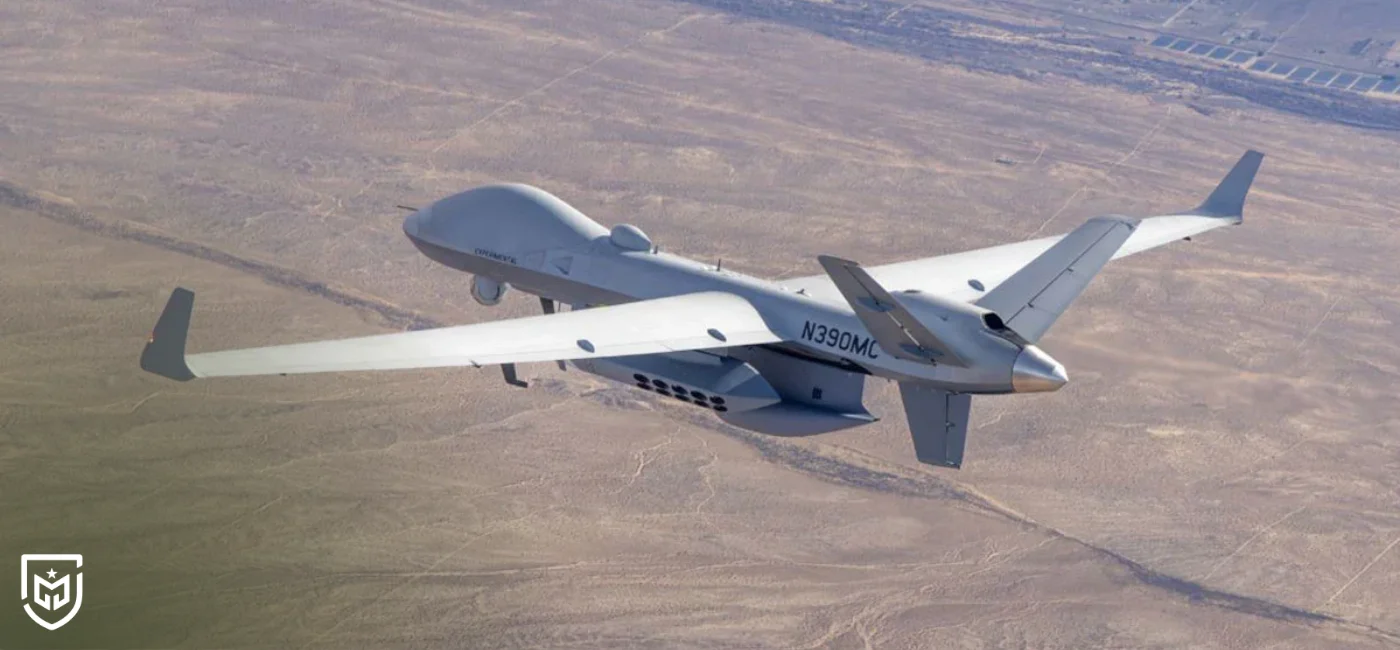
General Atomics Aeronautical Systems and Sweden-based Saab have reached an important milestone with the integration of a new airborne early warning system onto the MQ-9B unmanned aerial vehicle. The LoyalEye AEW pods, developed under a joint program by the two companies, successfully completed their first flight test on the MQ-9B platform. The test flight was conducted on May 19, 2026, from the Desert Horizon flight operations center in Southern California.
The LoyalEye system integrated onto the MQ-9B aims to provide unmanned aerial vehicles with long-endurance early warning and airspace surveillance capabilities. During the flight, the MQ-9B was seen carrying two underwing pods. Earlier concept visuals had also shown a third centerline pod, which was not clearly visible in the test imagery. Previous statements indicated that two pods would carry radar arrays, while a third under-fuselage pod would house data processing systems.
GA-ASI stated that the flight represents the first phase of a development process expected to continue for several months. The company aims to conduct a full-capability demonstration test by the end of the year. The use of a General Atomics-owned MQ-9B platform in the test campaign indicates that the operational integration process is progressing in a controlled manner.
The new AEW solution is being developed for missions such as early threat detection, long-range surveillance, multi-target tracking and airspace monitoring. The system is designed to operate with beyond-line-of-sight communications and satellite communication infrastructure. With this architecture, the MQ-9B could support not only reconnaissance and surveillance missions but also wider air picture generation and command-control processes.
GA-ASI President David R. Alexander stated that the system will provide critical air surveillance capacity against cruise missiles, guided munitions, unmanned aerial vehicles, fighter aircraft and bombers. He also emphasized that medium-altitude, long-endurance unmanned systems such as the MQ-9B offer high operational availability while performing missions without putting personnel at risk.
Saab Surveillance President Carl Johan Bergholm described LoyalEye as a system developed to complement manned platforms. According to Bergholm, the system will provide users with higher situational awareness and greater operational flexibility. This approach suggests that future early warning missions may be supported not only by large and costly manned aircraft but also by unmanned systems.
General Atomics and Saab first announced their AEW pod development cooperation in June 2025. The companies stated that LoyalEye could be used on the MQ-9B SkyGuardian, SeaGuardian, the UK’s Protector RG1 and the short takeoff and landing-capable MQ-9B STOL variant. This flexibility offers an important advantage in adapting the system to different user requirements and changing mission profiles.
One of the main goals of the LoyalEye program is to develop a more affordable airborne early warning solution against advanced cruise missiles and swarms of low-cost drones. As aerial threats continue to diversify, the need for early warning systems is increasing. In this context, lower-cost unmanned platforms with long endurance are emerging as a new option for air surveillance missions.
Saab’s experience as the developer of the Erieye AESA radar system used on the GlobalEye early warning aircraft adds further interest to the LoyalEye project. However, there has been no official confirmation of a direct technical link between LoyalEye and Erieye. Even so, Saab’s background in airborne early warning and air surveillance is seen as one of the factors strengthening the potential of the MQ-9B-based solution.
The first flight of LoyalEye AEW pods on the MQ-9B marks an important development showing the expanding mission scope of unmanned platforms. The ability of medium-altitude, long-endurance UAVs to support critical missions such as airborne early warning, airspace surveillance and multi-target tracking could open the way for a more cost-effective and flexible architecture in modern air operations. If the program matures through full-capability demonstration tests, MQ-9B could stand out not only as a reconnaissance platform but also as an unmanned airborne early warning asset.





 Süheyla Yıldız

Post Comment
Comments
No comments yet.
Related News
SSB Sector Meeting: Focus on Supply Chain and Production Capabilities
Turkish defense industry signed 15 billion dollars in new contracts in 2026
SSB Hosts Second Supply Chain Strengthening Summit
Skyfall II Exercise: U.S. Army Demonstrates UAV Defense Capabilities in Germany
IDA Turkey 2026 Defense and Aviation Industrial Cooperation Days Launched
SSB Chief: Transparent Licensing Will Strengthen Defense Cooperation
STM's Swarm UAV System Demonstrates Operational Success at Ateş Serbest-2026
TUSAŞ Kamikaze UAV Systems Achieve Success in Exercise Ateş Serbest-2026