


Naval Forces News
Global Developments


BREAKING NEWS
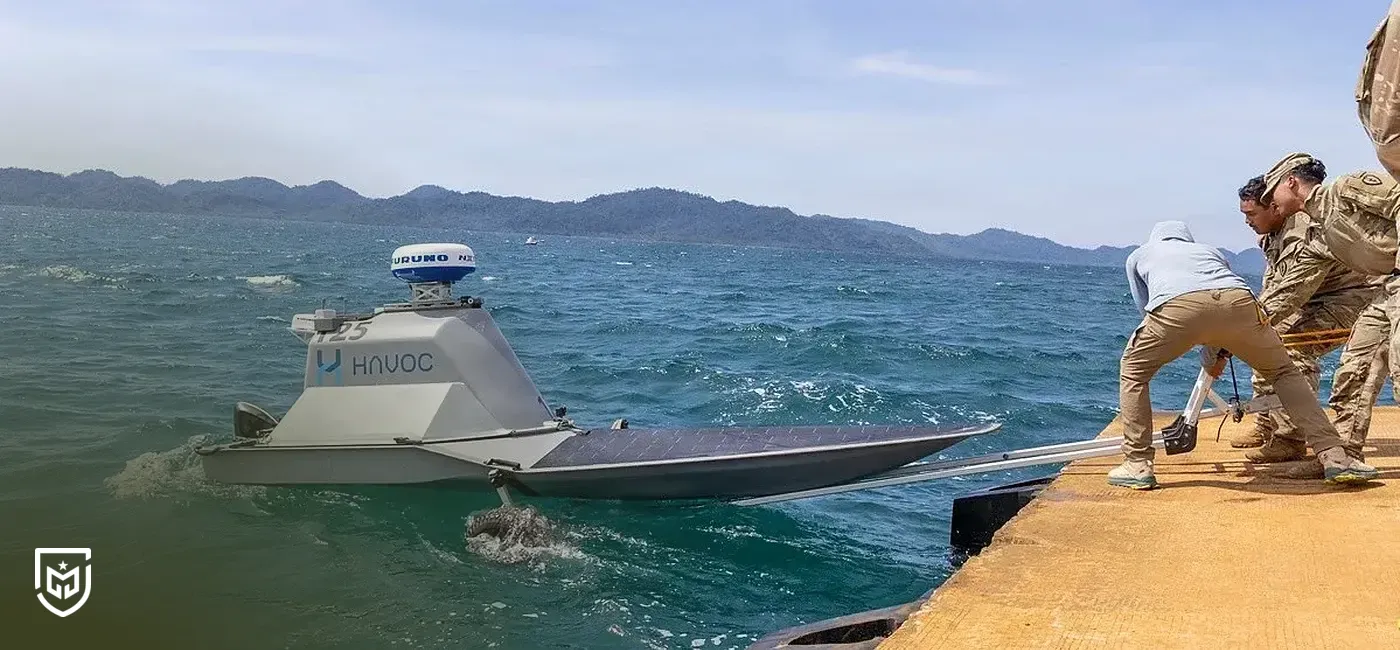
The US Army's 25th Infantry Division, specifically the 125th Military Intelligence and Electronic Warfare Battalion, deployed autonomous unmanned surface vehicles (USVs) in Casiguran Sound during the Salaknib 2026 exercise conducted with the Philippine Armed Forces. During the operation, these vehicles transited ahead of a US Army Logistics Support Vessel (LSV), conducting environmental surveillance and relaying real-time intelligence to personnel ashore. The exercise supported the transport of Philippine Armed Forces personnel and equipment, including armored personnel carriers, over a distance exceeding 400 kilometers to Casiguran Port.
Unmanned surface vehicles are autonomous maritime platforms employed for intelligence gathering, surveillance, and reconnaissance missions in naval environments. These systems utilize integrated sensors to operate independently, detect potential threats, and provide commanders with continuous operational awareness. During the Salaknib exercise, Specialist Caleb Hannah noted that the USVs escorted the logistics support vessel from approximately six nautical miles offshore to the port, enabling Philippine vessels to approach the pier safely. Such autonomous systems enhance convoy security while reducing personnel risk in contested maritime areas.
From the perspective of Turkish defense industry development, the advancement and operational employment of unmanned surface vehicle technology directly supports the modernization of naval capabilities. The global defense sector increasingly integrates USV systems into critical maritime missions including surveillance, mine countermeasures, and convoy protection. The US Navy's investments in this domain respond to growing security requirements in the Indo-Pacific region. Similarly, Turkey's efforts to strengthen maritime defense capabilities incorporate autonomous naval systems as a significant component of force modernization initiatives.
The US Navy is implementing a substantial expansion of its unmanned surface vehicle fleet. The force, which operated approximately four medium-class USVs in April 2026, aims to increase this number to over 30 by 2030. This expansion will occur alongside thousands of smaller USVs and unmanned aerial vehicle systems. This strategic investment demonstrates that autonomous systems will assume increasingly central roles in Indo-Pacific maritime operations. Data collected during exercises validates the operational effectiveness of these systems and identifies necessary improvements for next-generation platforms.
Within the global defense sector, US advances in USV technology encourage NATO allies and regional powers to develop comparable systems. Autonomous surface vehicles deliver extended operational duration and lower costs compared to traditional maritime surveillance methods. Multinational exercises such as Salaknib 2026 provide essential platforms for testing operational applicability and establishing international standards. The Turkish defense industry monitors these developments closely, evaluating opportunities to integrate similar technologies into domestic naval system programs and accelerating indigenous capability development.


The cookies used on our website are used to provide you with a better user experience and to improve our website. You can manage your cookie preferences from the options below.
 Tolga Demirel
Post Comment
Comments
No comments yet.
Related News
Germany denies claims of MGCS tank project withdrawal
Thales Introduces HexaForce AI-Powered Command and Control System to Gulf Region
Romania Signs Contract for Airbus H225M Helicopter Procurement
Ari Arms begins OR-4 rifle production in Azerbaijan
Ireland selects Thales Ground Master radar for air surveillance capability
Greece reaches agreement with US for Stryker armored vehicles
German F125 Frigates to Receive IRIS-T SLM Air Defense System Integration
France successfully conducts first test of M51.3 submarine-launched ballistic missile