


Land Forces News
Global Developments


BREAKING NEWS
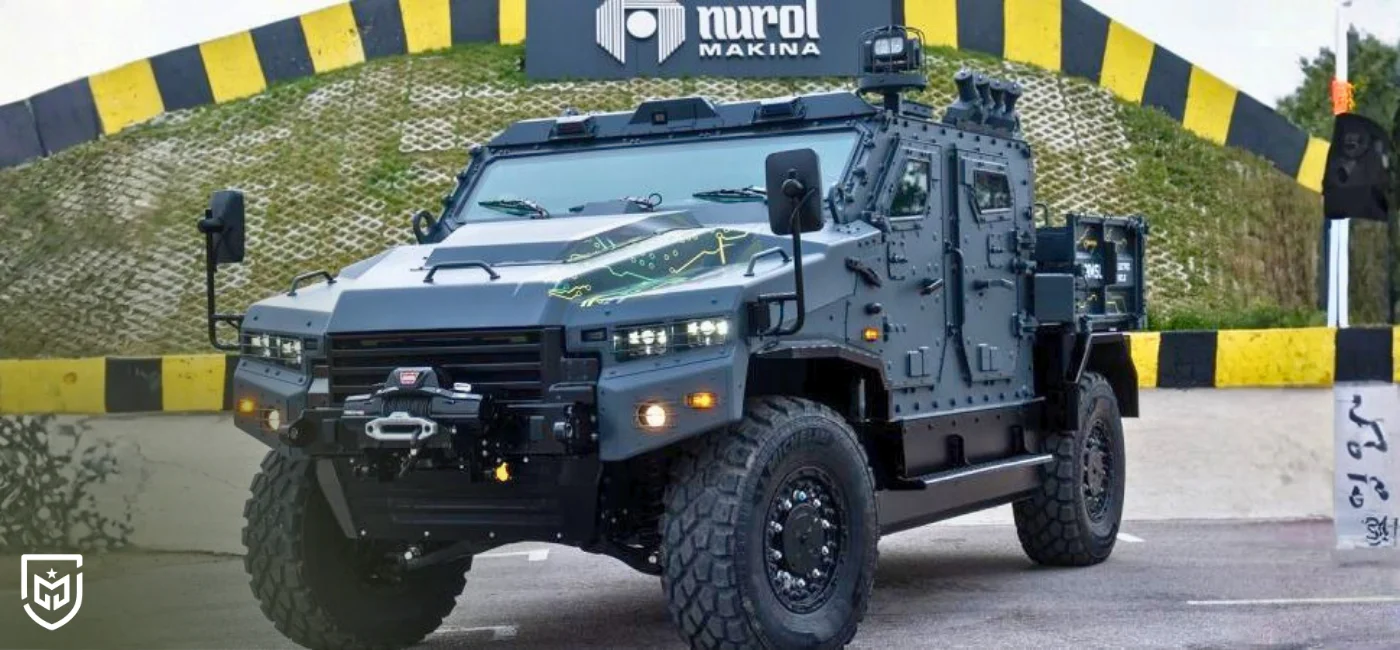
Turkish armored vehicle manufacturer Nurol Makina is expanding its vehicle family with a new-generation electric configuration. At SAHA 2026, the company is expected to present its latest platforms, including NMS EWB, NMS-L, EJDER YALÇIN Ambulance, and the most striking newcomer, eNMS-L. This move shows that Turkish defense industry companies are no longer focusing only on conventional armored platforms, but are also investing in future-oriented mobility solutions.
Among the vehicles to be displayed, NMS EWB 4x4 has been designed with a longer wheelbase to provide greater interior volume and higher carrying capacity. This allows more room for mission-specific equipment, personnel, or modular payloads. NMS-L 4x4, on the other hand, stands out as a lighter armored configuration in the 8–10 ton class, built for a wide range of missions such as reconnaissance and weapons carriage. EJDER YALÇIN Ambulance preserves the core capabilities of the base vehicle while adapting them to military medical evacuation standards.
The most notable development is the eNMS-L, a fully electric military vehicle created by transforming the NMS-L platform into a next-generation silent mobility solution. The vehicle has been developed with low thermal signature, quiet operation, and an environmentally conscious architecture, making it a candidate for future military roles where stealth and reduced detectability are critical. According to project officials, the design phase began around two years ago, the assembly has been completed, and the vehicle has now entered long-range and environmental testing. Payload integration tests are expected to follow, with all testing aimed to be completed by the end of the year.
The electric architecture offers important operational benefits. By removing the internal combustion engine and transmission and replacing them with a single electric motor, the vehicle gains a simpler and more responsive structure. This reduces mechanical delay and improves agility. The platform is said to offer a range of around 200 kilometers, depending on terrain and driving conditions. These features make it especially suitable for missions where low visibility and rapid reaction are more important than sustained high-speed movement.
The most likely mission profile for eNMS-L appears to be reconnaissance, observation, and lead-vehicle duty. Thanks to its low noise and heat output, it could operate ahead of convoys, potentially without onboard personnel, while maintaining communication with command elements. Remote-control integration is also planned, with early tests expected to include day and night reconnaissance scenarios. In addition, the vehicle retains important military features such as a fire suppression system, CBRN protection, central tire inflation, and the mobility characteristics of the base NMS-L platform, including water fording, slope climbing, and obstacle crossing performance.
Overall, eNMS-L represents a new step for the Turkish defense industry in the field of electric armored vehicles. Although it is still in testing, its concept responds directly to modern operational needs such as silent movement, reduced thermal detectability, and remote use. If the program progresses successfully, eNMS-L could open a distinctive niche not only for Türkiye’s armed forces, but also in the international defense market.


The cookies used on our website are used to provide you with a better user experience and to improve our website. You can manage your cookie preferences from the options below.
 Süheyla Yıldız
Post Comment
Comments
No comments yet.
Related News
SSB Sector Meeting: Focus on Supply Chain and Production Capabilities
Turkish defense industry signed 15 billion dollars in new contracts in 2026
SSB Hosts Second Supply Chain Strengthening Summit
SSB Chief: Transparent Licensing Will Strengthen Defense Cooperation
Görgün: Turkish-German defense partnership to be revitalized with new vision
Spain Plans to Purchase 15 Additional Hürjet Advanced Trainers
Turkey and Spain to Develop Joint Version of Hürjet Aircraft
Romanian Corvette Conducts Black Sea Exercises