


Land Forces News
Electronic Systems


BREAKING NEWS
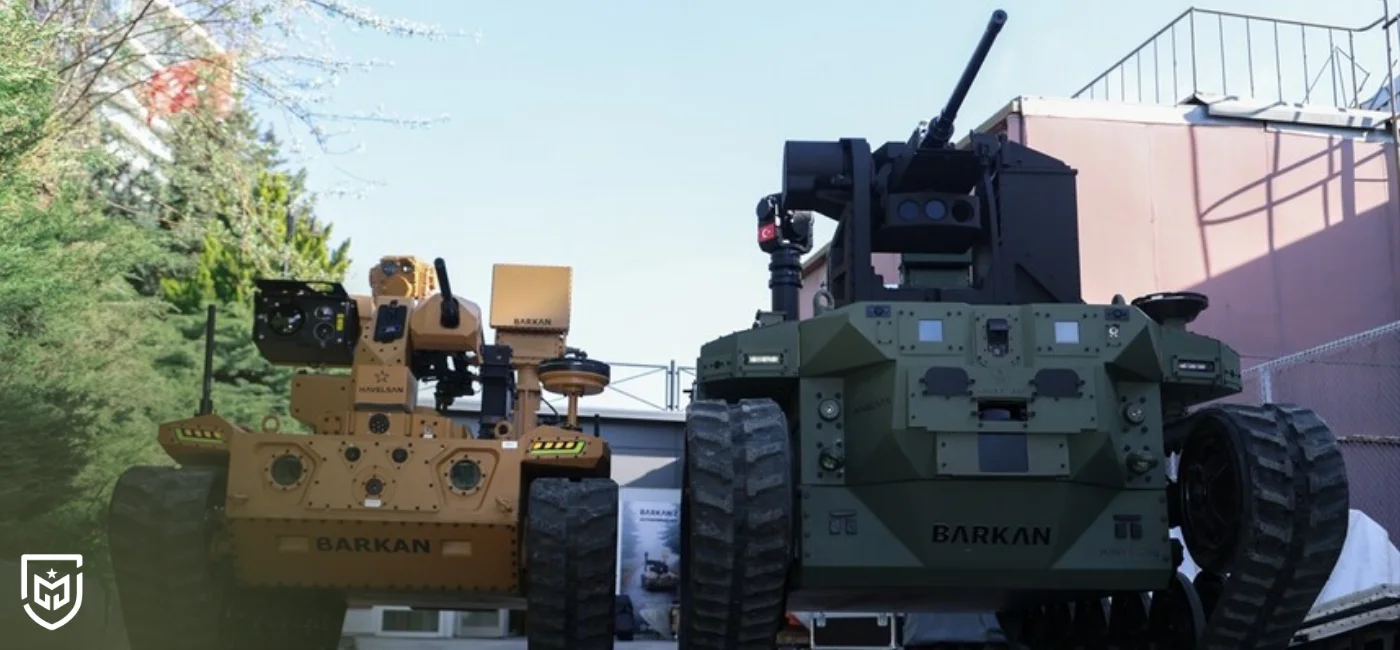
HAVELSAN’s BARKAN unmanned ground vehicle family took the field during the EFES-2026 Exercise, demonstrating Türkiye’s growing capabilities in autonomous land systems. Developed to support military units in modern combat environments, BARKAN is designed to reduce personnel risk, provide close support and perform reconnaissance and surveillance missions in dangerous areas without exposing soldiers directly to threats.
The BARKAN family stands out as an unmanned ground vehicle solution shaped by the operational needs of the Turkish Armed Forces. The platform can be remotely controlled and also offers autonomous mission execution capabilities. This allows it to perform tasks such as reconnaissance, surveillance, target detection, area control and intervention without requiring personnel to enter high-risk zones. In areas such as urban operations, border security, critical facility protection and dangerous combat zones, systems like BARKAN are expected to serve as important force multipliers.
The newer versions of the BARKAN family developed by HAVELSAN draw attention with increased payload capacity, enhanced autonomy and the ability to carry different mission systems. BARKAN 3 can reportedly operate with a 250-kilogram payload and has an approximate weight of 1 ton, a length of 2.7 meters and a width of 1.5 meters. The platform is designed to meet multi-layered battlefield requirements with features such as 360-degree perception, an expanded sensor architecture and integrated unmanned aerial vehicle management.
With BARKAN 3, the platform’s capabilities in the medium-class unmanned ground vehicle segment have been further improved. Its mobility, ground clearance, maximum speed and carrying capacity have been enhanced in line with field requirements. Capabilities such as a maximum speed of more than 25 kilometers per hour, crossing 35-centimeter vertical obstacles, passing 70-centimeter trenches, operating on 60 percent side slopes and moving through 50-centimeter-deep water show that BARKAN 3 is designed for challenging terrain conditions.
One of the most important advantages of the BARKAN family is its ability to be configured with different mission payloads. The platform has a flexible architecture that can support reconnaissance and surveillance, border security, critical facility protection, mine and improvised explosive device response, close fire support and target detection missions. Potential payloads include 7.62 mm and 12.7 mm weapon systems, radar surveillance systems, thermal and daytime reconnaissance systems, mine and IED countermeasure equipment and anti-tank missile integration.
In terms of autonomy, BARKAN 3 has a significantly strengthened sensor and software infrastructure compared to earlier versions. The platform includes 16 cameras, next-generation stereo cameras, LiDAR systems, radar-based autonomy sensors, 3D mapping, dynamic route planning, GPS-independent mission capability, leader-follower mode and obstacle avoidance features. These capabilities position BARKAN not merely as a remotely operated vehicle but as an advanced unmanned system capable of performing certain missions with its own decision-support functions.
The participation of the BARKAN family in EFES-2026 shows that unmanned ground vehicles are gaining a larger role within joint operations. Today, unmanned land systems are becoming increasingly important alongside unmanned aerial vehicles. These systems reduce the risks faced by personnel while providing units with broader situational awareness, faster response options and safer mission execution. The cooperation of autonomous systems with land forces points to a future battlefield where manned and unmanned elements will operate together.
BARKAN is one of HAVELSAN’s key projects that transfers its expertise in software, artificial intelligence, command and control, and autonomous systems to land platforms. Its appearance at EFES-2026 demonstrates the level reached by the Turkish defence industry in robotic ground systems and strengthens the goal of providing domestic and national solutions for the operational needs of the Turkish Armed Forces. As BARKAN becomes more widely used in the field, unmanned ground vehicles are expected to take on more active roles in reconnaissance, surveillance, security and fire support missions.



The cookies used on our website are used to provide you with a better user experience and to improve our website. You can manage your cookie preferences from the options below.
 Süheyla Yıldız
Post Comment
Comments
No comments yet.
Related News
Skyfall II Exercise: U.S. Army Demonstrates UAV Defense Capabilities in Germany
IDA Turkey 2026 Defense and Aviation Industrial Cooperation Days Launched
SSB Chief: Transparent Licensing Will Strengthen Defense Cooperation
STM's Swarm UAV System Demonstrates Operational Success at Ateş Serbest-2026
ÇAKIR Cruise Missile Supply Contract Signed
Drone Shield Showcased at Marksman Competition
Fire Free-2026 Exercise Successfully Completed
Görgün: Turkish-German defense partnership to be revitalized with new vision